
Capybara Jump: Cake Tower
CAT StudioCasual
4.5165.00 Reviews
- Version
- 0.0.44
- Installs
- 1.00M
- Age Rating
- Everyone
Screenshots
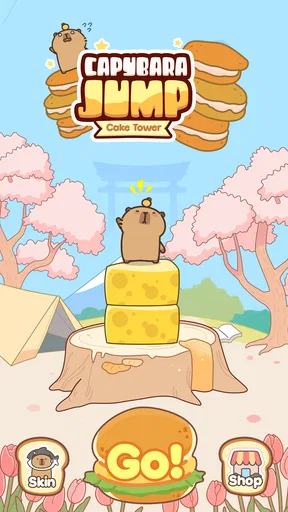







Our Review of Capybara Jump: Cake Tower
 Analysis by Appyee
I spent time with Capybara Jump: Cake Tower expecting a simple reflex game, and that is exactly what it delivers: a light, cheerful jumping challenge built around a capybara trying to climb a tower of cakes. My overall view is positive, but with an important qualification. This is best understood as a short-session casual game rather than a deep arcade experience. It is easy to start, pleasant to look at, and suitable for quick breaks, yet players searching for extensive progression or complicated strategy may run out of reasons to return.
The central idea is immediately clear. You guide the cute character upward by landing on cake platforms and trying to build the tallest tower possible. The appeal comes from that simple question of whether your next jump will be clean or whether a small mistake will end the attempt. It is the kind of design that works without a tutorial-heavy opening because the objective is readable almost at once.
How the cake-tower challenge feels in everyday play
I find the cake-tower challenge works best when I treat a run as a chance to notice one small timing detail, rather than as a demand to beat my previous height every time. That approach keeps a missed landing from turning a spare moment into a frustrating retry spiral, and it makes the game easier to enjoy in brief, interrupted sessions.
A simple premise with surprisingly focused timing
The strongest part of the game is its narrow focus. There is no need to learn a large collection of systems before playing well. I can open it, understand the immediate goal, and concentrate on positioning and timing. That makes it a natural choice for a short wait at a bus stop, a few minutes before an appointment, or a quiet break when I do not want to commit to a long session.
That simplicity does not mean every attempt feels identical. The tension comes from treating each landing as a small decision. I found myself paying more attention after a successful sequence because a taller tower creates its own pressure: the higher I get, the less willing I am to make a careless move. The game turns a very small action loop into a personal challenge to beat the previous height.
For me, the capybara theme is more than decoration. The friendly character and cake setting soften the frustration that usually comes with failed jumps. A mistake feels like a reason to try again rather than a harsh punishment. That tone is important for a casual title aimed at broad audiences, and it helps explain why the game can appeal to younger players as well as adults looking for something uncomplicated.
What makes it enjoyable beyond the store pitch
The most useful way to approach the game is to treat every run as practice in rhythm rather than rushing upward. I initially wanted to react to each platform separately, but better attempts came when I watched the movement as a repeating pattern and prepared slightly earlier. That small change made the controls feel less random and gave me a clearer sense of improvement.
Another practical observation is that short sessions work in the game’s favor. If I play for too long without a break, the repeated jumps become less satisfying because the basic objective remains unchanged. When I return later, however, the same compact loop feels refreshing again. I would therefore recommend playing in focused bursts instead of expecting it to occupy an entire evening.
The game also suits a shared, informal setting. Someone can watch a run and understand what is happening without knowing the controls or the rules. That makes it easy to hand the phone to a friend or family member for a quick attempt. It is not a multiplayer experience in the usual sense, but comparing who can reach a higher tower can create a small social challenge without requiring a complicated setup.
Where it sits among casual alternatives
Compared with puzzle games in the same broad casual space, this one asks for faster reactions and less planning. A puzzle title may reward careful analysis over several minutes, while this game is about making a clean decision in the moment. Compared with endless runners, it feels more concentrated: the cake tower is the entire focus, rather than a long path filled with several kinds of obstacles or collectibles.
That distinction helps define its audience. If I want a game that I can understand instantly and play with one hand during a spare moment, this is more convenient than a larger arcade or adventure title. If I want a story, a map to explore, character upgrades, or a long-term campaign, I would choose something else. Capybara Jump: Cake Tower does not need those additions to work, but its limited scope means it should not be judged as though it were trying to provide them.
Small habits that improve a run
My first tip is to avoid treating every jump as an emergency. A hurried correction often creates a second mistake, especially when the previous landing has already given enough time to prepare. I had better results by watching the capybara’s position relative to the next cake and making one deliberate adjustment instead of several nervous ones.
My second tip is to use failed attempts as information. Rather than restarting immediately with the same timing, I tried changing only one part of the approach: starting the movement earlier, holding a direction for less time, or waiting briefly before committing. That turns the retry loop into a small experiment and makes the game feel more skill-based.
A third useful habit is to stop after a particularly frustrating sequence. Because the controls and objective are so accessible, it is tempting to keep repeating the same attempt while becoming less attentive. A short pause often helps more than another rushed try. This is especially relevant for children, who may enjoy the character but need a clear stopping point when repeated failures stop being fun.
The main weakness: charm cannot replace variety forever
The meaningful limitation is the narrow replay structure. The cake tower is appealing, but the game’s core activity remains the same from one attempt to the next. I enjoyed chasing a better result, yet I could also see why a player who needs frequent new goals might lose interest. The experience depends heavily on whether personal improvement is enough motivation.
This is not a flaw in the controls or the visual idea; it is a question of expectations. A casual game can be successful without a large content catalog, especially when it is free to start. Still, players should know that the cute presentation does not automatically create deep progression. If your ideal game gives you new abilities, changing environments, or a substantial collection system, this will probably feel too modest.
The in-app purchase range is from $2.99 to $4.99 per item. I would approach those purchases carefully and first decide whether the basic jumping loop holds my attention on its own. For a game whose main value is quick, repeatable play, optional spending should feel like a personal choice rather than something needed to justify downloading it. The sensible approach is to enjoy the free experience first and only consider an item if it clearly adds value to the way you already play.
Who should download it
I think this is a good fit for casual players who like short reflex challenges, friendly characters, and goals that can be understood immediately. It is also a reasonable choice for families seeking an approachable game with an Everyone content rating. The absence of a complicated premise makes it easy for a new player to try without needing someone else to explain a long list of mechanics.
It may also work well for people who normally avoid games because they seem demanding. The capybara and cake theme make the first impression welcoming, while the vertical challenge provides enough tension to keep a short session from feeling completely passive. Someone who wants a small game for occasional use will probably get more from it than someone looking for a daily progression project.
I would skip it if I need a strong narrative, extensive customization, strategic depth, or a large variety of activities. I would also look elsewhere if repeated attempts at the same central challenge feel monotonous to me. The game is not trying to compete with a full platform adventure or a feature-heavy arcade package, and choosing it for those reasons would lead to disappointment.
Device compatibility and practical expectations
The game supports devices running Android 7.1 or later, which covers a broad range of phones and tablets. Its current version is 0.0.44, and the developer is CAT Studio. Those details are useful when deciding whether an older device is suitable, although the real question for most players will be whether the screen feels comfortable for precise jumps.
Because the game depends on timing, I would play on a device where touch input feels responsive and the display is easy to watch. A cramped screen may make small adjustments less comfortable, particularly during a higher run when concentration matters more. That is not a reason to reject the game, but it is worth considering if you plan to use an older or unusually small phone.
The game is free, and its broad reach is reflected in more than a million installs and an average rating of 4.5 from around thirty-five thousand ratings. Those figures suggest that the straightforward concept connects with a sizeable audience, but they do not change the central trade-off: popularity does not turn a compact loop into a deep one. I would use the free entry point to judge the game personally rather than assuming the audience size guarantees a perfect fit.
How I would recommend using it
For a new player, I would begin with several short attempts and focus on learning the movement rather than chasing an impressive tower immediately. The first goal should be consistency. Once landings feel more predictable, the challenge becomes more satisfying because a failed run feels connected to a specific decision instead of pure bad luck.
For parents or anyone sharing the game with a child, I would frame it as a quick score challenge rather than an endless activity. Taking turns can make the simple premise more engaging, and discussing why a jump failed encourages observation without turning the session into a lesson. The gentle theme is a good match for that kind of low-pressure play.
For experienced arcade players, I would recommend treating it as a palate cleanser between larger games. It can provide a few minutes of focused timing without asking for a major commitment. I would not make it the only game installed if I wanted a constant stream of new challenges, but it can fill the role of a friendly, immediately playable diversion.
My final assessment
Capybara Jump: Cake Tower succeeds because it understands its own scale. It offers a cute setting, a clear objective, and a compact jumping loop that is easy to pick up but still gives room to improve. I especially like how a small adjustment in timing can turn an unsuccessful run into a more controlled one, giving the game a little more substance than its cheerful appearance first suggests.
At the same time, the limited structure is impossible to ignore. After the novelty of the capybara and cake tower settles, continued enjoyment depends on whether I genuinely like repeating the climb and improving my result. Players who want variety should choose a more expansive casual game, while players who appreciate focused, bite-sized challenges will find a better match here.
My recommendation is straightforward: try it if you want a free, approachable reflex game for short sessions, and keep your expectations centered on timing rather than progression. Its best quality is the balance between instant accessibility and a small but real skill curve. With an Everyone rating, support for older Android versions, and a friendly presentation, it is easy to suggest to the right person. I would just describe it honestly as a charming quick-play challenge, not as a long-form game designed to keep revealing new systems.
Verdict
Strengths of Capybara Jump: Cake Tower
- Simple one-touch controls are easy to learn.
- Short rounds make it suitable for quick gaming sessions.
- Cute capybara visuals give the game a charming personality.
- Vertical tower levels provide a clear sense of progress.
- Playable offline, making it convenient while traveling.
Limitations of Capybara Jump: Cake Tower
- Repeated jumps can become predictable after extended play.
- Precision landings may feel frustrating on smaller screens.
- Progress may rely heavily on replaying similar tower sections.
- Limited gameplay variety can reduce long-term engagement.
- Ads may interrupt the experience between attempts.
Other Releases by CAT Studio
View All
Car Wash Simulator: ASMR Game
Role Playing4.2

Antistress Relaxing Mini Games
Casual4.4
Similar Picks in This Category
View All
My Talking Angela
Outfit7 Limited4.2

My Talking Tom
Outfit7 Limited4.3

Pou
Zakeh4.2

My Talking Tom 2: Pet Game
Outfit7 Limited4.3

Candy Crush Saga
King4.6

Bridge Race
Supersonic Studios LTD4.1
Frequently Asked Questions
What is Capybara Jump: Cake Tower?
Capybara Jump: Cake Tower is a casual vertical-jumping game centered around an adorable capybara climbing a tower made of cakes and other sweet platforms. The main objective is to jump upward, avoid falling, and reach higher sections while improving your score. Its simple controls and cute presentation make it suitable for short play sessions and players of many ages.
How do you play Capybara Jump: Cake Tower?
Gameplay is designed to be easy to understand, although reaching the highest parts of the tower can require practice. You guide the capybara from platform to platform, carefully controlling its movement and timing each jump. Players need to watch platform positions, avoid missed landings, and react quickly as the tower becomes more challenging. The game focuses on timing, accuracy, and score improvement.
Is Capybara Jump: Cake Tower free to download and play?
Capybara Jump: Cake Tower can generally be downloaded without an upfront purchase, but availability, advertisements, and optional in-app purchases may depend on the version and device platform. Before installing, users should check the official Google Play or App Store listing for current pricing details. If the game includes optional purchases, they are not normally required to enjoy its basic jumping gameplay.
Does Capybara Jump: Cake Tower require an internet connection?
The core jumping experience may be playable without a constant internet connection, which makes the game convenient for quick sessions while traveling or when mobile data is unavailable. However, features such as advertisements, leaderboards, cloud-related services, updates, or in-app purchase verification may require connectivity. Requirements can vary between Android and iOS versions, so checking the store description is recommended.
Is Capybara Jump: Cake Tower suitable for children?
The game’s cute capybara character, colorful cake-themed design, and straightforward controls make it generally approachable for children and casual players. Nevertheless, parents should review the age rating and privacy information before installation, particularly if the version contains advertisements, external links, or optional purchases. Younger children may also need supervision to prevent accidental purchases or extended play sessions.
Play our best games!


